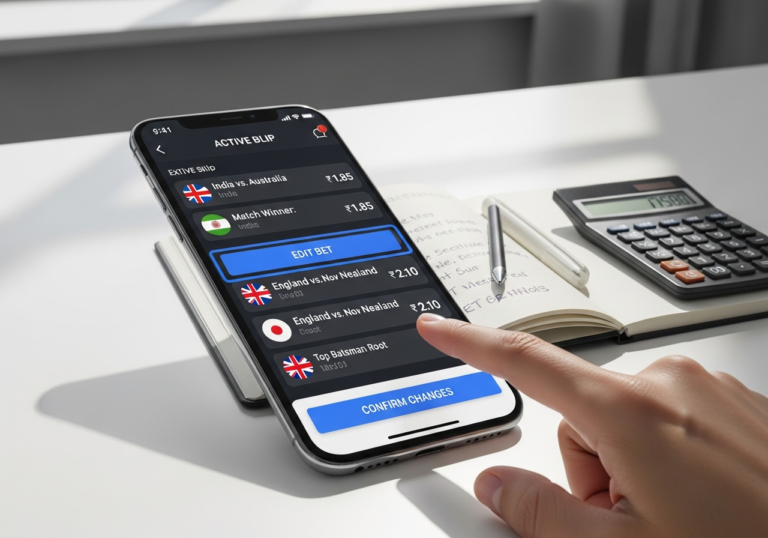
Cash out is a feature available on most Indian sports betting platforms that allows you to settle a bet early for a bookmaker-determined amount based on the current odds and match situation. Unlike a standard withdrawal of funds from your account, cash out is a pricing feature that lets you close an active bet before the event concludes, instantly crediting the settled amount to your betting balance. This tool has become essential for Indian bettors navigating the volatile markets of IPL cricket, ISL football, and other live sports, offering a way to lock in profits, reduce potential losses, or manage risk in real time. However, cash out comes with hidden costs—bookmakers shade these offers below fair value to maintain their edge—so understanding when and how to use it strategically is crucial to protecting your long-term profitability.
What Cash Out Means on Indian Sportsbooks
Cash out is fundamentally an early settlement mechanism. When you place a bet on an Indian sportsbook and the match begins, the live odds change continuously based on events unfolding on the field. A cash out offer allows you to accept a price from the bookmaker and close your bet immediately, regardless of the final outcome. The amount you receive is calculated by the platform using your original stake, the odds at the time of bet placement, the current live odds, and the bookmaker’s margin. Once you confirm a cash out, the bet is settled, the amount is added to your betting balance (not withdrawn to your bank account), and you have no further exposure to that particular wager.
It is important to distinguish between cashing out a bet and withdrawing funds from your account. Cash out is a trading feature embedded in the betting interface—it represents accepting a new price to close a position mid-event. Withdrawing funds, by contrast, is a banking operation that moves money from your betting balance to your Indian bank account via UPI, netbanking, or other local payment methods. Cash out eligibility also varies by market and bet type; not every selection or promotion qualifies, and certain events (like during a cricket wicket or football penalty) may temporarily suspend cash out offers.
Core Mechanics: Early Settlement and Live Pricing
When you cash out a bet, the bookmaker’s system processes your request instantly and locks in a price based on the live probability of your bet winning at that exact moment. The cash out amount reflects what the bookmaker believes your bet is currently worth, accounting for all information available—match score, time elapsed, player injuries, weather conditions, and any other relevant factors. Once you confirm, the bet closes immediately. You receive no further updates on that wager; if your selection wins after you have cashed out, you do not benefit. Conversely, if your selection loses after you have cashed out, you have already protected your stake or profit.
This immediacy is powerful in volatile Indian sports. An IPL batter may be dismissed moments after you cash out, or an ISL goalkeeper may concede a late goal. By settling early, you eliminate the uncertainty associated with the remaining match time.
Difference Between Cash Out and Normal Payouts
Under normal circumstances, you place a bet and wait for the event to finish. The sportsbook then settles all open bets automatically: if your bet wins, you receive your stake plus winnings at the original odds; if it loses, your stake is forfeited. This settlement happens once and is binding.
Cash out, by contrast, allows you to intervene before the match ends and accept a new offer. If you bet ₹1,000 on India to win a T20 at 2.50 odds (potential return of ₹2,500), and India reaches the final over looking strong, the live cash out might offer ₹2,200—less than your potential full win but significantly more than your stake. If you accept, you pocket ₹2,200 immediately and your original bet is closed. If you decline and India wins, you get the full ₹2,500. If you decline and India loses, you lose the ₹1,000. Cash out thus trades potential upside for certainty.
Types of Cash Out Offered by Indian Betting Sites
Indian-facing sportsbooks typically offer three main varieties of cash out, each providing a different level of control and exposure management. Understanding the distinctions helps you choose the right tool for your betting situation.
| Cash Out Type | How It Works | Typical Use Case | Risk/Reward Profile on Indian Markets |
|---|---|---|---|
| Full Cash Out | Entire stake and all remaining exposure is settled for a single lump sum. Bet closes completely. | Single bets on match outcomes, odds boosts nearing expiry. | Low volatility: you lock in a fixed return. Forgoes all upside if bet moves in your favour. |
| Partial Cash Out | Split your stake into two parts. One part is cashed out and settled; the other remains open for the full match. | IPL accumulators with 2–3 legs remaining. Late-innings chases or final-quarter comebacks. | Medium volatility: you bank partial profit while retaining exposure to bigger upside. |
| Auto Cash Out | You preset profit or loss thresholds. The system automatically cashes out when the offer reaches your target without requiring manual action. | Mobile bettors unable to monitor live markets. Managing downside on multi-leg accas during overnight matches. | Customisable: removes emotion and ensures discipline, but may execute during temporary odds spikes. |
Full Cash Out
Full cash out closes your entire stake and settles the bet for the amount displayed on the platform at that moment. You receive no further involvement with that wager. On Indian betting apps, this option appears prominently in your “My Bets” or “Open Bets” section whenever the feature is available for that market.
Full cash out is most useful when you want certainty. If you have backed a cricket team at long odds and they have achieved a strong position mid-innings, accepting full cash out locks in a profit without the risk of a sudden collapse. For example, if you bet ₹500 on a Test match draw at 4.00 odds (potential payout ₹2,000) and the match reaches day five with both teams tightening up, the cash out might offer ₹1,800. Accepting this removes the anxiety of a final-day innings victory negating your draw bet.
However, full cash out also means you forfeit any remaining upside. If circumstances change in your favour during the remaining match time, you will not benefit.
Partial Cash Out on Indian Platforms
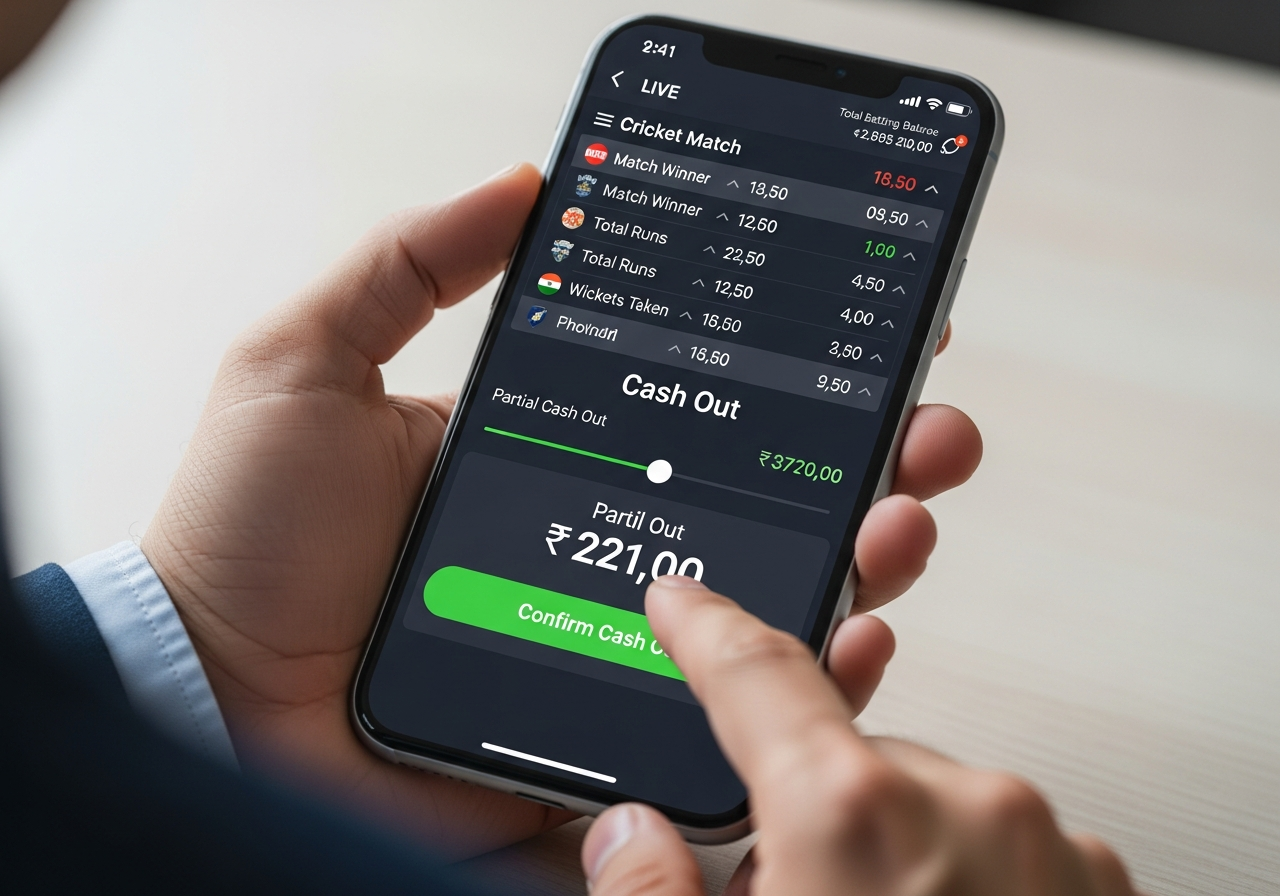
Partial cash out splits your original stake into two independent bets. You choose how much of your stake to cash out (often via a slider or percentage selector in the app), and the remaining portion continues to run until the event concludes.
- Strategic Profit Banking: Lock in part of your gain while keeping half your stake in play for a potential bigger win.
- Ladder-Down Approach: On a four-leg accumulator, cash out part of the stake after three legs have won, then let the final leg determine the rest.
- Momentum-Aware Betting: In IPL, if a batting team has lost early wickets but you still believe they will post a total above 160, cash out half at current odds, keep half riding.
- Risk Segmentation: Useful when you hold conviction but want to reduce variance. If you bet ₹2,000, you might cash out ₹1,000 for ₹1,100 (locking in ₹100 profit) and leave ₹1,000 to run for the full payout.
- Timing Flexibility: Partial cash out lets you act on changing match conditions without abandoning your view entirely.
- App Interface: Most Indian sportsbooks show a slider under the cash out section; you drag it to select your proportion, and the offered return updates in real time.
Balancing Profit-Taking vs. Upside
Partial cash out addresses a common dilemma in live betting: wanting to protect profit without completely cutting yourself off from a big win. In IPL chases, if the batting team has been 50 runs ahead through 15 overs but has just lost two quick wickets, partial cash out lets you cash in on the progress made so far while risking only half your stake on the remaining scramble. Similarly, if you placed a multi-leg accumulator on an ISL match and the first two legs have landed, you might cash out 60% to lock in, say, ₹3,000, and let the remaining 40% (₹600 stake) run on the third leg for ₹1,800 if it wins.
This balances psychology and maths: you secure a portion of your gain, reducing the emotional impact of a late loss, while maintaining exposure to profitable scenarios.
Interface and Limits on Indian Apps
Indian betting platforms typically allow you to partial cash out within a minimum and maximum range—often 10% to 90% of your stake. Some platforms restrict partial cash out on complex bets (like same-game multis or heavily boosted accumulators) or when promotional funds are involved. If your bet includes a bonus, the platform may disable partial cash out on the portion funded by the promo, allowing it only on your deposited stake. Always check the bet slip or “My Bets” screen to confirm that partial cash out is available before you plan your exit.
Auto Cash Out and Preset Rules
Auto cash out lets you set automatic settlement conditions. Instead of monitoring your open bets manually, you tell the platform, “Cash me out when my profit reaches ₹1,000” or “Cash me out if I’m down to a loss of ₹500,” and the system executes the trade when the cash out offer meets your threshold.
- Log into your account and navigate to your open bets or bet slip.
- Select a bet eligible for auto cash out and tap the auto cash out option.
- Choose your trigger type: either a target profit (e.g., ₹2,000) or a stop-loss limit (e.g., –₹500).
- Enter the amount and confirm. The system will monitor the live odds continuously.
- Monitor the status: on your bet card, you will see a progress indicator showing how close you are to your threshold.
- Automatic settlement: when the cash out offer reaches your target, the platform cashes out instantly without requiring further action.
- Confirmation and balance update: you receive a notification, and the amount appears in your settled bets and account balance within seconds.
Setting Triggers for Auto Cash Out
Auto cash out works best when you pair it with clear thresholds set before the match begins. For instance, if you bet ₹1,000 on an IPL team at 1.90 odds and you want to take profits if they climb to ₹1,800, set an auto cash out at +₹800. Conversely, if you want to limit losses to ₹300, set a stop-loss. Indian betting sites display your current offer status in real time, showing you how far the current cash out amount is from your target—for example, “Current offer: ₹1,650 / Target: ₹1,800.”
This removes emotional decision-making, which is crucial during volatile cricket matches or nail-biting ISL finishes. By pre-committing to a rule, you avoid the psychological trap of hoping for one more run or goal and watching a winning position turn into a loss.
How Indian Bookmakers Calculate Cash Out Values
The cash out amount you see is derived from a formula that considers your original stake, the odds you took, the current live odds, and the bookmaker’s profit margin. While the exact calculation happens in real time on the platform’s servers, understanding the logic helps you evaluate whether a cash out offer is genuinely attractive or merely profitable for the house.
The fundamental principle is this: the cash out amount represents the fair value of your bet given the current odds, minus the bookmaker’s edge. If your bet has a 60% implied probability of winning at current odds, the fair cash out (ignoring margin) would be your stake multiplied by that probability. However, the bookmaker shades this down slightly to preserve their margin, so the actual offer is always a touch lower than the purely mathematical fair value.
Live Odds, Win Probability and House Margin
Consider a simple formula:
Cash Out Amount = Stake × (Current Win Probability – Bookmaker Margin)
This is not the exact formula used by Indian sportsbooks, but it illustrates the concept. If you bet ₹1,000 at 2.00 odds (implying a 50% win probability) and the current live odds move to 1.80 (implying a 55.6% win probability), the fair cash out would be roughly ₹1,000 × 55.6% = ₹556. However, if the bookmaker retains a 5% margin on cash out, the actual offer might be ₹1,000 × 50.6% = ₹506.
In practice, Indian platforms use continuous live-odds feeds and sophisticated probability models to compute cash out prices instantly. The key takeaway: the current odds are the primary driver. If your selection strengthens (shorter odds), the cash out rises; if it weakens (longer odds), the cash out falls.
Worked Examples on Cricket and Football Bets
Example 1: IPL Match Bet – Bet Ahead
You place ₹2,000 on Mumbai Indians to win at 1.83 odds (implied probability: 54.6%). At the time of cash out, Mumbai is 150/2 in 15 overs, chasing 175. Current live odds have shortened to 1.55 (implied probability: 64.5%). The fair cash out would be ₹2,000 × 64.5% = ₹1,290. Accounting for the bookmaker’s margin (say, 3–4%), the actual cash out offer is approximately ₹1,250. You accept, banking a ₹250 profit despite the match not being complete. If you had not cashed out and Mumbai won, your full payout would have been ₹3,660 (₹2,000 × 1.83). But if they lost in the final overs, you would have lost ₹2,000.
Example 2: ISL Match Bet – Bet Behind
You backed Kerala Blasters at 2.10 odds with ₹1,500, expecting a 47.6% win probability. After 60 minutes with the score locked at 0–0, the odds lengthen to 2.80 (implied probability: 35.7%). The fair cash out value is ₹1,500 × 35.7% = ₹536. With margin, the platform offers ₹500. You can accept ₹500 (losing ₹1,000 but avoiding a total loss) or hold for a 30-minute push. If Kerala scores and wins, you get ₹3,150 (₹1,500 × 2.10). If they do not, you lose ₹1,500.
These examples show why cash out can be rational in down scenarios (cutting losses) and tempting in up scenarios (locking profit)—but always slightly disadvantageous versus holding the original bet’s expected value.
Eligibility: Which Indian Bets Can Be Cashed Out?
Not every bet or market on an Indian sportsbook supports cash out. Eligibility depends on the bet type, the sport, current match phase, and promotional status. Understanding these restrictions helps you plan your bets and avoid frustration when you expect a cash out option but find it unavailable.
| Bet Type / Scenario | Cash Out Availability | Common Restrictions on Indian Sites | Examples |
|---|---|---|---|
| Single match winner bets | ✓ Yes (most live markets) | Suspended during key events (goal, wicket). Some exotic props unavailable. | India vs Australia ODI, Kolkata Knight Riders vs Delhi Capitals |
| Accumulator / Parlay bets | ✓ Yes (2–4 legs typically) | Often disabled for 5+ legs. May not be available until second leg is settled. | 3-leg cricket + football accumulators |
| Same-game multis / Live combos | ✗ Limited or No | Usually not eligible due to complexity and odds aggregation. | Multiple props within one T20 match |
| Odds-boosted bets | ~ Partial / Conditional | Cash out may be restricted to the deposited portion only, or disabled entirely until expiry time approaches. | “Boost your odds” specials on ISL matches |
| Free bet stakes | ✗ Often restricted | Some sites allow cash out only on profit above the free bet amount; others disable it entirely. | Welcome bonus free bet used on IPL final |
| In-play markets (live lines) | ✓ Yes | Available during live play but suspended during commercial breaks, technical issues, or odds recalculation. | Live run-line bets, ball-by-ball cricket markets |
| Early cash-out promos / specials | ~ Yes but with conditions | Some restricted-participation offers may disable manual cash out to force auto cash out or promote bonus reinvestment. | “Cash out at 50% profit” tournament offers |
Suspended Markets and Technical Limits
During a cricket match, cash out becomes unavailable during reviews, powerplays with rapid odds shifts, or after a wicket when the bookmaker’s systems are recalculating. Similarly, in football, cash out may disappear during penalty reviews, injury stoppages, or if a goal has just been scored and VAR is checking. These suspensions typically last 10–30 seconds but can feel frustratingly long if you are trying to act on fast-moving odds. Technical issues, such as connectivity problems on the Indian sportsbook’s infrastructure or your device, can also lock you out of cashing out temporarily.
Additionally, some Indian sportsbooks impose a soft suspension if the market is in heavy demand or if your specific bet is eligible but the bookmaker is not currently quoting a price (due to risk management). In such cases, refresh the page or wait a few moments for the offer to reappear.
Step-by-Step: Using Cash Out on Indian Betting Apps
Using cash out on your chosen Indian betting platform is straightforward, but the exact steps vary slightly depending on whether you are using a desktop site, Android app, or iOS app. Here is a generalised guide:
- Log in to your betting account using your username, password, and any two-factor authentication codes required.
- Place your bet as normal: select your market, enter your stake, and confirm. The bet is now live and the match begins.
- Navigate to “My Bets” or “Open Bets” – usually found in the main navigation menu or a dedicated tab on the app’s home screen.
- Locate your eligible bet in the list of active wagers. Cash out-eligible bets will display a “Cash Out” button or be highlighted with a special icon.
- Review the current cash out offer displayed next to or below the bet details. This amount updates in real time as odds shift.
- Tap or click the “Cash Out” button to view the exact amount being offered. Some apps show a confirmation dialog; others require you to confirm via a second screen.
- Confirm your decision by tapping “Accept” or “Confirm Cash Out.” The bet is now settled, and the amount is added to your betting balance instantly.
Finding Eligible Bets in ‘My Bets’
Once you are in the “My Bets” section, eligible bets are usually flagged with a green “Cash Out” button or a flash symbol indicating a live offer. Indian sportsbooks typically sort open bets by most recent or by sport, making it easy to scan for the bet you want to settle. The current cash out offer is shown in large text, often in a prominent colour, so you do not have to drill down into bet details. If a bet is not eligible (e.g., it is a free bet, suspended market, or unsupported bet type), the button will be greyed out or absent, sometimes with a tooltip explaining why. Check the bet status line to see if the market is suspended or if there is a technical issue preventing the offer.
Confirming and Tracking Cash Out Settlements
After confirming your cash out, the bet status immediately changes from “Open” to “Cashed Out” (or a similar label depending on the platform). The settled amount appears in your account balance right away—no waiting for the match to conclude. You can view the completed cash out in your “Settled Bets” or “Bet History” section, where it shows the original stake, cash out amount, and timestamp. Some Indian apps send a push notification confirming the settlement, and you will receive a bet receipt via email if you have notifications enabled. The amount is now available for withdrawal or further wagering.
Cash Out, Bonuses and Promotions in India
Indian sportsbooks frequently use cash out as part of their promotional strategy. Free bets, welcome bonuses, and odds boosts can all interact with cash out in ways that affect your ability to use the feature or the amount you are allowed to keep.
| Bonus Type | Cash Out Policy | Impact on Wager Requirements | Key Notes for Indian Players |
|---|---|---|---|
| Welcome / Sign-up Bonus | Often disabled or restricted. | Cashing out may void bonus or reduce eligible winnings. | Most sites require you to complete the full wager requirement before cash out is available on bonus-funded bets. |
| Free Bets | Restricted to profit above free bet amount. | Only winnings above the free bet stake can usually be cashed out; the free bet itself is not retrievable. | If you receive a ₹500 free bet and cash out for ₹700, you typically keep only ₹200 (the profit). The ₹500 is forfeited. |
| Odds Boosts / Enhanced Odds | Conditional; often disabled. | Boosted odds bets may not allow cash out, or cash out only on the deposited portion at base odds. | A 50% odds boost on a ₹1,000 bet may permit cash out only on ₹500 at regular odds, with the boosted portion locked until full settlement. |
| Cashback Bonuses | Usually available but may trigger clawback. | Cashing out a bet may forfeit associated cashback or require re-wagering of the cashback amount. | If you receive 10% cashback on losses, cashing out early may prevent the loss from registering and nullify your cashback eligibility. |
| Tournament or Promotion Specials | Highly variable. | Some restricted-participation offers require full bet settlement or prevent cash out to force specific outcomes. | IPL-specific promos may restrict cash out on the final match to push accumulator completions. |
| Reload Bonuses | Often available but with conditions. | Reload bonus wagering must be satisfied before cash out becomes available on bonus funds. | A 50% reload bonus on a ₹5,000 deposit (₹2,500 bonus) requires betting ₹12,500 of the total before cash out is enabled. |
Free Bets, Boosted Odds and Cash Out Restrictions
Free bets present a unique challenge. Many Indian sportsbooks allow you to place a free bet on any market, and if you cash out, you lose the free bet stake itself but keep any profit above that amount. For example, a ₹500 free bet cashed out for ₹800 returns ₹300 in real money (₹800 – ₹500). However, some sites disable cash out entirely on free bet stakes, forcing you to let the bet run to completion.
Odds-boosted bets are similarly restricted. If a sportsbook has enhanced your odds by 50%, they often disable cash out on the boosted portion to prevent you from arbitraging the boost or locking in guaranteed profit at the inflated odds. The solution is to read the terms and conditions for each promotion—Indian sportsbooks are increasingly transparent about these rules, but checking the “T&Cs” link on any bonus offer is essential before you rely on cash out.
Pros and Cons of Cash Out for Indian Bettors
Cash out is a powerful tool, but like any tool, it can work for or against you depending on your discipline, strategy, and the situation. Here is a balanced assessment:
- Flexibility and Control: You are no longer a prisoner to your original odds. If match circumstances shift dramatically, you can exit early without waiting for the final whistle.
- Risk Reduction on Volatile Markets: Cricket and football markets in India can swing wildly. A sudden injury, a momentum shift, or a controversial decision can tank your bet in seconds. Cash out lets you lock in profit before such events.
- Reduced Psychological Burden: Watching a winning position deteriorate to a loss is emotionally draining. Cashing out mid-way can ease anxiety and prevent stress-driven poor decisions.
- Hedge Against Odds Errors: Occasionally, a bookmaker may quote incorrect odds that favour you. Cashing out quickly locks in that edge before the correction.
- Variability Reduction: For bettors chasing specific targets (e.g., ₹1,000 daily profit), partial or full cash out reduces variance by locking in incremental gains.
- Lower Expected Value Over Time: Cash out offers are always shaded below fair value. If you use cash out frequently, you are systematically accepting suboptimal prices, eroding your long-term edge.
- Emotional Decision-Making: Many Indian bettors use cash out reactively, cashing out too early out of fear or chasing losses by refusing to cash out late. This kind of undisciplined use destroys value.
- Temptation to Over-Trade: The ease of cashing out can lead to excessive position-switching, incurring frequent small losses to bookmaker margins.
- Opportunity Cost: By cashing out a ₹1,000 profit from a bet with ₹3,000 upside, you forgo the full gain if your selection wins. Statistically, frequent early cash outs trade winning upside for safety.
- Interaction with Variance: If you are a value bettor with a long-term edge, cashing out to reduce short-term variance actually increases your expected loss because you are accepting worse-than-fair prices.
When Cash Out Helps Your Bankroll
Cash out is sensible in specific scenarios. If you hold a three-leg accumulator and the first two legs have landed, cashing out 70% of your stake locks in a tangible profit while leaving a smaller amount exposed on the final leg. If an IPL team is chasing 180 and reaches 150 in the 18th over, the odds have shifted massively in your favour; cashing out guarantees you capture most of that gain. Or if you bet on an ISL team when they were underdogs and they have now scored first, a partial cash out lets you bank that profit and reduce stress on the remaining time. These are high-conviction moments where cash out serves a valid risk-management function.
Hidden Costs of Overusing Cash Out
The problem arises with chronic cash-out usage. If you cash out on 50% of your bets, you are systematically accepting bookmaker margins on half your positions, which directly reduces your bottom line. Over a year of betting, this drag compounds. Additionally, cashing out winners (when you are ahead) more frequently than cashing out losers creates a behavioural bias: you lock in gains but hold losses, which is the opposite of the rule “let your winners run.” This pattern is particularly damaging because you are giving away the right tail (big wins) while clinging to the left tail (big losses). The bookmaker is happy because they earn margin on the cashed-out winners and win from the uncashed losses.
Strategy: Integrating Cash Out into Indian Live Betting
Cash out works best as part of a deliberate, pre-planned strategy rather than an emotional reaction. Here is a framework for using it wisely on Indian markets.
Before you place a bet, define your exit points: What profit level would make you satisfied enough to cash out? What loss would you want to cut? For an IPL accumulator, you might decide, “I will cash out 50% if I reach ₹2,000 profit on a ₹1,000 stake” or “I will cash out fully if I drop to a loss of ₹700.” By committing to these thresholds before the match starts, you remove the emotional component of the decision. When the offer appears, you simply follow your rule.
Contrast this with reactive cash outs. Many Indian bettors impulsively cash out when their selection is briefly ahead, fearing a reversal. They then watch helplessly as the bet would have landed for full value had they waited 30 more seconds. This reactive pattern is a money-loser. Instead, use auto cash out to enforce your pre-planned rules, removing temptation.
Pre-Planning Exit Points and Risk Limits
- Establish a profit target before placing your bet – decide in advance what percentage of your potential win would satisfy you (e.g., 60% of max payout).
- Set a stop-loss limit – define the maximum loss you are willing to accept before cashing out to cut downside exposure (e.g., lose no more than 30% of stake).
- Use auto cash out to execute your plan – configure the platform to automatically settle when your target or stop-loss is reached, removing discretion.
- Review your pre-planned thresholds in real time but do not deviate – watch the match, understand the odds movement, but stick to your rule unless circumstances have fundamentally changed (e.g., an injury to a key player not anticipated at bet time).
- Log your decisions – track which cash outs worked out well and which you regret, building a sense of which thresholds are optimal for your risk tolerance and the sports you bet on.
- Adjust for bet type and market volatility – cricket T20s are more volatile than Test matches; ISL matches are more volatile early on than late. Set looser thresholds for high-volatility bets and tighter ones for stable markets.
Indian Banking, KYC and Withdrawing Cashed-Out Winnings
A critical point often glossed over: cashing out a bet is not the same as cashing out to your bank account. When you cash out a wager, the amount is credited to your betting balance on the platform. To access your money in INR, you must then initiate a withdrawal through the platform’s banking interface, subject to Know Your Customer (KYC) verification and processing times.
| Method | Processing Time | KYC Requirements | Typical Use in India |
|---|---|---|---|
| UPI Transfer | 5–30 minutes | Full KYC (ID, address, PAN if required). Bank account linked to UPI. | Fastest, most popular method for Indian mobile bettors. Low fees. |
| Netbanking | 1–4 hours | Full KYC + bank account verification. | Direct, secure bank transfer. Subject to bank-side limits and processing. |
| Debit/Credit Card | 2–5 working days | Full KYC. Card must match account holder’s name (most platforms enforce this). | Slower but simple for users who funded via card. |
| E-wallets (Paytm, PhonePe, etc.) | 15–60 minutes | Full KYC. E-wallet account linked to betting account. | Growing popularity. Instant for some operators. |
| Cryptocurrency (if offered) | 10–30 minutes | KYC varies; some platforms offer crypto withdrawal with lighter KYC. | Faster, less regulated, but emerging in India’s betting ecosystem. Subject to local regulatory stance. |
From Cash Out Balance to INR
After you cash out a bet, the amount sits in your betting balance, often labelled as “Cash Balance,” “Wallet,” or “Account Balance” in the app. To convert this to INR in your bank account, follow these steps: First, ensure your account is fully KYC-verified. Most Indian sportsbooks require a photo ID (Aadhaar, PAN, or passport), proof of address, and bank account details. Second, navigate to the Withdrawal or Cashout section, distinct from the cash out feature on bets. Select your preferred withdrawal method (UPI is fastest) and enter the amount you wish to withdraw. Third, the platform processes your request, which involves confirming the withdrawal method and sometimes entering an OTP for security. Fourth, the funds are transferred to your linked bank account or e-wallet. Processing times range from 5 minutes (UPI) to several working days (cards), depending on the method and your bank’s processing speed.
Importantly, the amount you cashed out for does not change between the time you settle the bet and the time you withdraw. If you cashed out for ₹5,500, you will receive ₹5,500 (minus any withdrawal fees, which most Indian sportsbooks now waive for standard methods). The delay in processing is purely administrative.
Responsible Use of Cash Out in Indian Betting
Cash out is a tool, and tools can be used wisely or destructively. Using cash out responsibly means integrating it into a broader framework of bankroll management, discipline, and emotional control. Indian bettors face unique challenges: the excitement of IPL and ISL matches, the cultural normalization of betting in some communities, and the accessibility of mobile apps makes it easy to slip into excessive usage. Responsible use means acknowledging these pressures and taking proactive steps to manage them.
- Set daily, weekly, and monthly betting limits – define a maximum amount you will stake and stick to it, regardless of confidence or recent losses.
- Use cash out to enforce loss limits, not as an excuse to chase losses – if you have reached your daily loss limit, cash out your remaining bet and log out of the app.
- Avoid using cash out as a way to stay in the action longer – partial cash outs can tempt you to keep re-staking profits into new bets, increasing overall risk.
- Track your cash out usage and outcomes – are you cashing out winners more than losers? This bias suggests emotional decision-making, not rational strategy.
- Use platform tools like deposit limits, reality checks, and time-outs – most major Indian sportsbooks now offer these features; activate them to prevent excess.
- Separate betting funds from essential money – only bet with discretionary income you can afford to lose without impacting your life.
- Be aware of the regulatory landscape in your state – some Indian states have clearer legal frameworks for sports betting than others. Understand your local rules and avoid illegal bookmakers.
Avoiding Emotional Cash Out Decisions
The biggest risk is using cash out to feed emotional impulses. Cashing out too early out of fear (even when your bet is statistically likely to win) is a classic mistake. So is refusing to cash out late in a losing position, hoping for a miracle comeback. The antidote is to pre-commit to rules and let auto cash out enforce them. If you have set a stop-loss of –₹500 on a ₹1,500 bet and the match is spiralling against you, accepting the cash out loss of ₹500 is far better than holding to a complete ₹1,500 loss. Emotionally, it feels like failure, but mathematically, it is discipline. Conversely, if your bet is strongly ahead and you have reached your pre-defined profit target, cashing out feels like leaving money on the table—but you have already captured the upside, and anything beyond is volatility you do not need.
Setting Limits and Using Site Tools
Most Indian sportsbooks now offer responsible gambling tools. Deposit limits cap how much you can add to your account per day, week, or month. Reality check messages remind you of your spend when you are wagering heavily. Self-exclusion tools allow you to lock yourself out of the platform for a cooling-off period if you sense you are losing control. Time-out features limit your session duration. Use these aggressively. If you find yourself cashing out bets five times a day, you are probably over-betting; activate a time-out or deposit limit to slow yourself down. If you are chasing losses by cashing out on accumulated bets, you are caught in a loss-recovery spiral; self-exclude for a week and reset.
Cash out is a powerful feature that can enhance your enjoyment of betting and protect your bankroll when used wisely. The key is understanding its mechanics, calculating when the offer genuinely benefits you, and using it as part of a structured strategy rather than an emotional escape hatch. By integrating cash out into a framework of pre-planned thresholds, auto-execution, and responsible bankroll management, Indian bettors can harness its benefits while avoiding the hidden costs that make it so profitable for bookmakers. Remember: cash out is a tool that the bookmaker has given you. Use it strategically, not impulsively, and you will find it a valuable part of your betting arsenal.